Let us help you lift it—with tools designed to guide, empower, and transform those you serve. Change can happen. Make sure this arrest is their last.
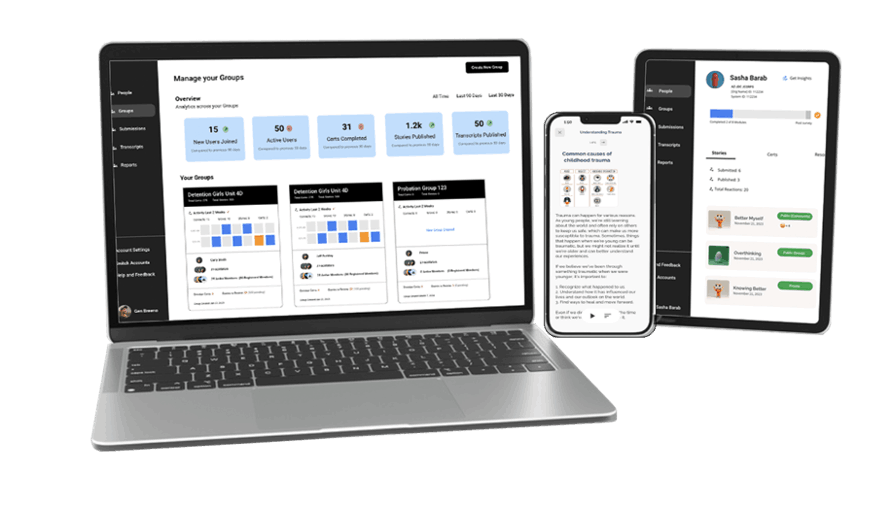
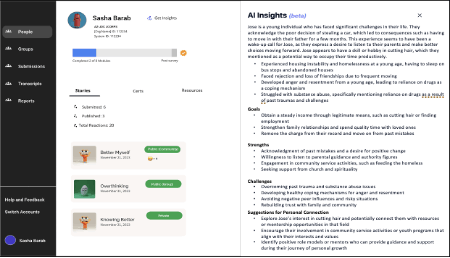
Advanced AI delivers personalized insights and feedback, driving consistent and impactful growth. Gain actionable insights and identify patterns, create growth and transition plans, and to improve outcomes across individuals and organizations. Our AI tools enhance your staff's ability to support behavioral change at scale.
Anytime-anywhere programs for youth and adults covering core criminogenic needs (pro-social skills, family relations, substance use, etc.), gun safety, substance prevention, re-entry, adulting, and more. With our next-generation app, programs can be delivered across all contexts of care: secure settings, probation, and diversion.

Coaches/Growth Specialists guide every step of the journey, alleviating burdens on staff while ensuring program fidelity. Coaches provide strength-based feedback and personalized care, using evidence-based practices to ensure quality care. We are here to support your staff, running our programs or supporting your staff.
At Life Lab Studios, we’ve created Journey.Do—an innovative program that partners with justice leaders to support the transformation and growth of justice-involved individuals. Designed to address the critical challenges facing departments and their staff, Journey.Do helps adults and young adults build essential life skills while equipping your team with advanced tools and data-driven insights to achieve better outcomes.
Many solutions focus on one approach—therapy, small groups, academic content—but we combine decades of research across multiple fields with cutting-edge technology and AI to deliver real results.
Journey.Do offers a next-generation solution, grounded in research, combining advanced technology, trained coaches, and AI to deliver high-quality, consistent change at scale. We ensure growth happens from intake to outtake—every time.
Grounded in our research-based, behavioral change framework, our programs ensure every person receives the same quality of care from intake to outtake.
We provide structured programs that support individuals to avoid formal prosecution while addressing risks and needs.
Our programs offer an alternative to traditional sentencing, equipping individuals with tools for long-term success.
We enhance probation outcomes with AI-powered coaching and real-time engagement to reduce recidivism.
Our platform transforms incarceration into an opportunity for growth, preparing individuals for reintegration.
We bring immediate access to growth journeys in short-term settings to foster change before reentry.
Our structured programs support participants in mental health, drug, and veterans’ courts with targeted interventions.
Think of Alcoholics Anonymous, group therapy, and Weight Watchers. They all use small groups, with numerous studies illustrating how small groups uniquely promote personal change (Borek & Abraham, 2018; Rosendahl et al. 2021; SAMHSA, 2015). Small groups promote engaged participation and sense of belonging, as well as the power of peers in emphasizing the relatable, real-world struggles of applying what one is learning (Barab & Duffy, 1998; Berg, Landreth, & Fall, 2018; Lave & Wenger, 1991). The value of small groups and communities of practice on growth and learning has been demonstrated through hundreds of studies. (Hattie, 2010).
Meta-analyses have also shown that small-group learning increases academic achievement, improves attitudes towards learning, and increases persistence to completion. (Springer, Stanne, & Donovan, 1999). Another compelling meta-analysis showed that small group learning increases student’s transfer performance – their ability to apply what is learning to another situation. (Pai, Sears, Maeda, 2015).
In Journey.do, we provide a social growth platform and app where group leaders support community members in growing capacity to achieve meaningful goals as part of a safe and supportive group where they are seen, valued, and validated for their growth and impact stories.
Research shows that our motivations for learning are central to what we learn. People learn more when knowledge stays connected to what they can do with it (Barab & Duffy, 2012; Cobb & Bowers, 1999; Mclellan, 1996). People are willing to work harder to learn content and skills they see as useful and connected to future goals (Yeager, Walton, & Cohen, 2013), and especially when they are are invested in the outcome (Billett, 1996; Greeno, 1989; Hattie, 2009). When learning starts with “why” content matters, learners have greater personal investment, knowledge application, and show higher skills development (Bransford, Brown, & Cocking, 2002; Sawyer, 2022).
People learn better when they are interested, curious, passionate, engaged, pursuing goals that matter to their life (Bransford, Brown, & Cocking, 2000; CTGV, 1991/1993; Immordino-Yang & Faeth, 2010). We need to reframe content around its real-world value. If the goal of learning is to enable people to function in the world, then we need to engage them in those tasks as part of the learning process (Engle, 2006; Gresalfi & Barab, 2011).
In Journey.do, each Module is positioned as a goal, beginning with a statement of real-world importance, providing connection to real-world stories, and the expectation of applying what one is learning, with each achievement being a step along the journey.
Stories connect and persuade us, affecting us in deeply emotional ways. Stories provide a means of sharing history, tacit knowledge, critical thinking, important details, and even specific skills for succeeding in real-world situations (Bruner, 2002; Gray, 2009; Gottschall, 2012). Stories are personal, contextual, and relational, affirming possibility, reinforcing identity, and validating transformation (Barab, Dodge, Ingram-Goble, Pettyjohn, Peppler, & Solomou, 2010). Even anonymous story-telling among peers showed mental health benefits (Collins, Arbour, et al., 2022). Stories create an opportunity to rewrite those narratives of self (Kenyon & Randall, 1997; Mclean, Pasupathi, & Pals, 2007).
Sharing personal stories reinforces and gives value to diverse voices and unique identities, which when valued creates a sense of “rightful presence, central for people to feel like they belong, that they matter, and their voice counts (Barton and Tan, 2020). Stories connect us to other people, affirming our personal struggle and recognizing our successes(Sackstein, 2017). Recent neuroscience research has found that when someone reflects on key lessons to be learned from stories, they can form new neuronal connections; thereby, expanding connections in their brains (Immordino-Yang & Knecht, 2020).
In Journey.do, stories are a key value-proposition, providing a useful means of articulating growth, an impetus for engaging in learning (as members connect with each other’s story while aspiring to create their own), and are considered part of the knowledge the platform provides.
Our childhood experiences set the stage for every critical life outcome. For decades, the robust literature on adverse childhood experiences (ACEs) has routinely shown that experiencing adverse, traumatic, and disadvantaged environments dramatically undermines youths’ life outcomes (Felitti et al., 1998). Specifically, youth who have been exposed to ACEs are more likely to drop out of school, to be unemployed, to report poor mental and physical health, and to be involved in delinquency (Leban & Gibson, 2020; Narvey et al., 2021; Wolff et al., 2020). In fact, upwards of 90% of youth who come to the attention of the JJS display enormous amounts of ACEs—far more than youth in the community (Baglivio & Wolff, 2021; Cronholm et al., 2015; McCarter & Durant, 2022; Schauss et al., 2020; Zettler & Craig, 2022). What makes it worse is that these ACEs, and other risk factors, can lead to criminogenic needs that, if not addressed, often lead towards become justice-involved (National Research Council, 2013).
That is the sad news. The good news is that research has shown that resulting criminogenic factors are dynamic or changeable. In fact, research has shown that when criminogenic factors are turned from risk to protective factors, they can reduce recidivism and contribute towards positive change. Further good news is that adolescence create a unique and critical window for change: neuroscience shows that the brain is actively pruning and growing new neuronal pathways at this time (Immordino-Yang & Knecht, 2020; Romer, Reyna, & Satterthwaite, 2017; NRC, 2013); social psychology shows that peer influence drives development and can dramatically impact behavior change (Collins, Arbour, et al., 2022; Chein, Albert, O’Brien, Uckert, & Steinberg, 2011; Laursen & Veenstra, 2021; Maxwell, 2002), and developmental psychology indicates that identity formation can go a dramatic transformation during adolescence (Collins, Arbour, et al., 2022; Kenyon & Randall, 1997; Mclean, Pasupathi, & Pals, 2007).
In Journey.do we see the youth arrest as providing an opportunity during a critical window for change, one where we have taken advantage of the power of story and practice given the research showing them both impactful to lighting/creating brain pathways, social validation and belonging given the documented meaningful impact on youth choices, and praise, feedback, and application given there critical role in learning and behavioral change.
Champions propel learning in unique ways by: Setting up conditions to maximize learning by building a safe community with successful cohorts (Borders, 1991; Frei & Morris, 2020); Creating a sense of group culture and mood(Sy, Côté, & Saavedra, 2005); Providing personalized direction and setting relevant goals (Cloud & Townsend, 2010; Roth, 1986); Offering rich feedback in a personal and supportive manner (Hattie, 2009); Introducing relevant knowledge (Kivlighan & Dennis, 2010); Facilitating conversations and useful member connections (Morrison, 2002). Champions operate in ways similar to coaches, with a deep focus on ways that ensure each youth is making progress on there unique journeys. Their goal is to be supportive, inspirational, and provide critical feedback to ensure youth are growing with a balance between feedback that is trauma-informed, strength-based, and inviting youth to expand their thinking in ways that go beyond simply validating where they are if an opportunity for further growth exists.
In a synthesis of over 900 meta-analyses, feedback was found to be one of the most powerful influences on learning and achievement, especially when targeted towards personally-valued goals, was delivered in a manner that is strength-based and was designed to improve performance—rather than simply stating that they got it right or wrong (Hattie & Timperley, 2007; Hattie, 2009). People are more willing to grow when they feel seen and valued for where they are, even as they are invited to grow into a new possibility. Peers can become champions over time. They are often perceived as less judgmental than experts, an provide insights about the struggles in practice that facilitators might not, and “Speak the same language” (Borders, 1991; Ladyshewsky 2006; Secomb 2008).
In Journey.do, we offer a range of services to ensure that every member is supported by a strong champion, who dynamically engages learners, provides rich feedback, personalizes trajectories, and facilitates asset-based conversations and impact across the small group journeys.
Trauma-Informed Care is an approach to supporting youth that recognizes the impact of trauma and prevalence of adversity that youth have experienced and aims to respond in a way that avoids re-traumatization and promotes healing (Bent-Goodley, 2019; Yatchmenoff, Sundbork, & Davis, 2017). This approach is centered on the principles of safety, choice, collaboration, and empowerment and involves communicating in a manner that avoids inadvertently repeating unhealthy interpersonal dynamics in the helping relationship (Knight, 2015; Levenson, 2017). The Substance Abuse and Mental Health Services Administration (SAMHSA, 2019) has provided a comprehensive guide to trauma-informed care that involves (a) realizing the widespread impact of trauma, (b) recognizing the signs and symptoms of trauma, (c) responding by fully integrating knowledge about trauma into interactions, and (d) seeking to actively resist re-traumatization by providing feedback that is safe, supportive, and empowering.
Strength-based feedback is a type of feedback that focuses on highlighting a person's strengths, abilities, and positive qualities, rather than solely focusing on their weaknesses or areas for improvement (Brough, Bond, & Hunt, 2004; Rashid, 2015). This type of feedback aims to build on a person's strengths and create a supportive, growth-oriented environment, rather than one that is solely critical and negative. By recognizing and building on the positive aspects of an individual, strength-based feedback can help promote confidence, resilience, and motivation (Hammond, 2010; Xie, 2013). Strength-based feedback should involve specific and concrete examples of the individual's strengths in action with feedback that encourages the individual to continue to build on their strengths and positive qualities (Laursen, 2000).
In Journey.do, champions are trained to provide feedback that is trauma-informed and strength-based. At the same time they hold high expectations, ensuring youth are addressing the story criteria and feedback will often invite the learner to engage all areas of the Module as they consider future possibilities often in a story revision.
We offer a community solution for managing protective factor growth, guided by your assessment or our inventory.
We provide complete protective factor journeys, comprised of 7-8 modules each, to support diverted youth.
We provide complete protective factor growth journeys to support youth on probation.
We have built a safe and secure process for using our app on managed tablets in detention. Groups mirror the youth in your units.
Contact us for a brochure and demo. We will walk you through the platform and cater the services to meet your needs.
Yes, we provide “Tiered Pricing” which means you can get discounts on license costs when you qualify to enter into higher tiers.
We use a suite of evidence-based practices, including motivational interviewing, trauma-informed care, strength0based communication, single-session intervention, and peer-based learning. Our core connect-grow-apply-inspire framework is also grounded in learning sciences research, as is the larger behavioral change framework (see journey_BCF)
No, part of the power of the innovation is we use devices that youth already have or are available. Within secure care, you can use a tablet and download the journey.do app at the Apple an Google stores, or even use the school computers on any browser, and clients login with a modified 2FA in which their authentication codes are provided by staff. Similarly, clients outside of secure locations can download the app or use a browser with safe and secure authentication.
Every organization has it's own custom instance, and each officer or case manager, has their own group within the instance where they register users. Staff can access the coaching dashboard either through our apps or via browser.
Yes. We have created an application ecosystem and company culture that meets SOC-2 and HIPAA requirements with all the necessary privacy and safety features to keep your organization and participant data safe. Each group can also turn on and off particular features, based on their needs. Our robust security measures include encryption for data at rest and in transit, strict AI safeguards, role-based access control (RBAC), multi-factor authentication (MFA), and a multi-tenant architecture, ensuring data integrity and responsible handling.
Our AI systems are built with privacy, fairness, and security in mind. No user data is stored, shared externally, or used to refine AI models. All AI-generated insights are reviewed by staff before being shared, ensuring human oversight and mitigating biasJourney.do was designed to operate in either a single or multi-tenant environment and therefore can be used safely in secure care. Access or privacy and security policy, or learn more by visiting our safety and security overview.
We understand the high demands placed on staff and have designed the Journey.Do experience to offer flexibility, allowing staff to engage at whatever level they feel is appropriate. Clinicians and Coaches can run the program or their efforts can be supported through our Recovery Coaches. They will always have access to the platform and can use it as a tool to further engage with their participants, gaining valuable insights into their progress.
Our dedicated account team will work closely with your staff to ensure that each staff’s participation aligns with their preferences and responsibilities. Together, we will co-serve the participant from intake through outtake, providing consistent support and personalized attention to help them succeed at every stage of their journey.
Our Growth Coaches are certified through the LLS coaching academy and are well-versed in each of the specialty and evidence-based journeys you will facilitate. They are expertly trained to use AI for accountability and insights, ensuring they can provide the most impactful support to both staff and participants. All of our Coaches are trained in trauma-informed care and strength-based communication, enabling them to engage participants in a constructive, empathetic manner. We regularly audit their responses to ensure the feedback provided is helpful and consistent, while continuously updating our training with real-world examples to enhance the JourneyDo experience.
Note: To safeguard participants, any story that is reviewed can be marked private. If a story is submitted that raises concerns for a participant's safety, we promptly notify the appropriate contact to ensure timely intervention